For CPAs & tax preparers
A more organized property file for your professional review.
Help clients document rental-property facts, inventory, costs and supporting records before you evaluate classifications and return treatment.
The professional handoff
Review the facts without rebuilding the client’s inventory.
Property and basis facts
Review purchase information, land allocation, ownership facts, dates and reconciliation.
Itemized asset information
Inspect rooms, item quantities, entered amounts, suggested classifications and spreadsheet output.
Visible review points
Identify estimates, missing evidence, assumptions and facts requiring further evaluation.
Explore the actual workflow
See the organization behind the CPA handoff.
Explore a synthetic long-term rental record and its advisor-role example. The collaboration panel is simulated: it does not send an invitation or share a customer file. Review the underlying facts and report structure through the app’s native tabs.
This fictional example is separate from your customer account. Start a real property through the free property check when you are ready.
Check My Property — Free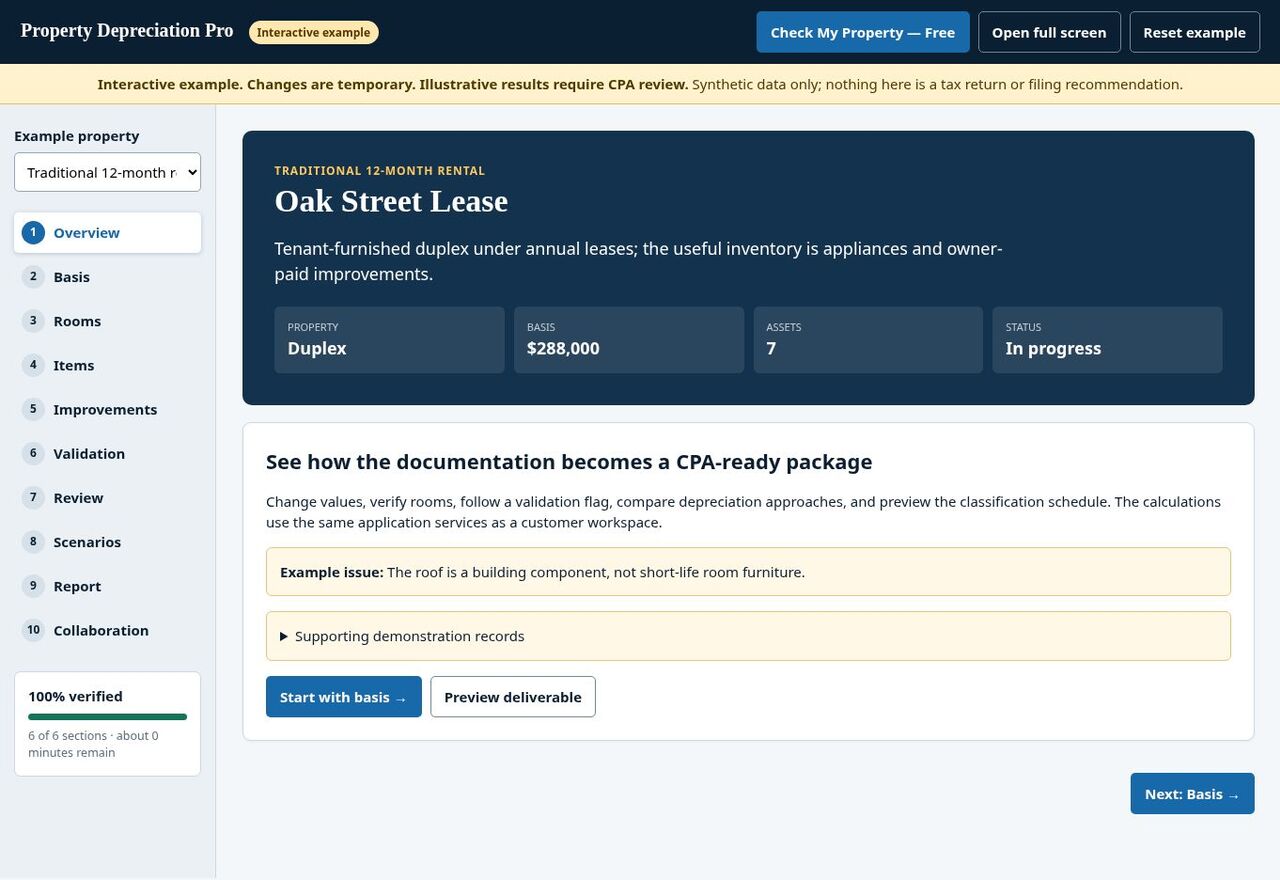
Explore synthetic property information using the app’s native tabs. You provide facts and supporting records; PDP organizes them for professional review.
This sample is not your saved customer property or a filing recommendation. Your tax professional determines final treatment.
What PDP organizes
- Guided collection of client-provided property facts.
- Room-by-room furnishings and equipment inventory.
- Appliance and improvement records.
- Available supporting documents and photographs.
- Suggested classifications and modeled depreciation assumptions.
- Report, asset schedule and professional handoff materials.
What remains your decision
- Whether facts and supporting records are sufficient.
- Appropriate basis, allocations and classifications.
- Applicable methods, elections and return treatment.
- Taxpayer-specific limitations and deduction usability.
- Handling of prior returns or accounting-method issues.
- Whether a specialist study or other engagement is needed.
A practical client-to-CPA workflow.
Client documents the property
The owner records facts and inventory through the guided intake, identifying estimates and missing support.
Client prepares the handoff
After purchase and completion requirements, the owner accesses available files and project-sharing controls.
You evaluate the file
Review the facts, request corrections or support, and determine treatment under your own professional engagement.
Review scope
PDP review is separate from your engagement.
Automated checks identify missing or unusual entries. Flagged reports receive human review; unflagged reports can proceed through automated approval.
Neither path replaces your evaluation of the client’s records or determines a tax-return filing position.
The standard package is not an engineering-based cost-segregation study.
Inspect the sample first
The anonymized sample includes estimates and no uploaded supporting evidence. It illustrates how review requirements appear in the output.
Professional questions.
Does PDP prepare or file the client’s tax return?
No. The standard package supplies documentation and preparation materials for professional review. Return preparation and filing are outside its scope.
Does the spreadsheet import directly into my tax software?
The sample is a CSV asset schedule. Do not assume direct compatibility with a tax-software import format; review your software’s requirements.
Can I see estimates and missing support?
The report and supporting-record information identify assumptions and documentation status. Review the sample to see how those limitations are presented.
What does the standard package cost?
$395 per qualifying property, with no subscription. Review checkout for any applicable authorized professional code or portfolio discount.
When should a client use a specialist instead?
When property complexity, allocations or the required professional methodology exceed the guided package’s scope. Determine the appropriate engagement before relying on the output.